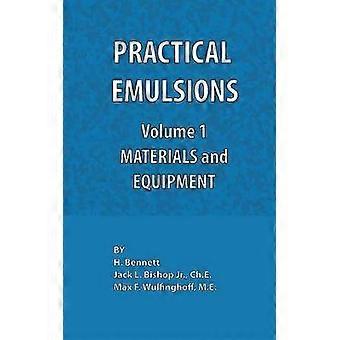
Practical Emulsions Volume 1 Materials and Equipment
$189.00
+ $6.99 Shipping

Practical Emulsions Volume 1 Materials and Equipment

Sold by:
Practical Emulsions Volume 1 Materials and Equipment

$189.00

In stock
+ $6.99 Shipping
Taxes calculated at checkout

14-Day Returns Policy

Payment methods:

  • Brand: Unbranded

Product details

Product details

Practical Emulsions Volume 1 Materials and Equipment

CONTENTS - INTRODUCTION - 1. BASIC CONSIDERATIONS - Solutions-Suspensions-Emulsions-Surface Activity - 2. PROPERTIES OF EMULSIONS - Particle size and arrangement ; Rheology ; Micelle Theory ; Stability and Interfacial Phenomena ; Causes of Unstable Emulsions - 3. INGREDIENTS AND ADDITIVES - Surfactants-Emulsifying Agents ; Wetting Agents ; Foamers ; Protective Colloids ; Preservatives - 4. ANALYSIS AND TESTING OF EMULSIONS - Type of Emulsion ; Density ; Viscosity ; Surface Tension ; Particle Size ; Water ; PH-Color OdorCorrosion ; Stability ; Performance ; Analytical Procedures ; ASTM Specifications - 5. TECHNIQUES OF EMULSIFICATION - English Method-Continental Method - 6. EMULSIFYING EQUIPMENT - Low-Shear-High-Shear-Rotor-Stator ; Pressurized Fluid ; Vibrational Devices ; Laboratory Equipment - 7. EMULSION PLANTS AND PRODUCTION MACHINERY - Over-all Plan ; Modes of Operation ; Power Requirements ; Mixing Tanks ; Pumps ; Conveyors ; Materials of Construction ; Instrumentation ; Packaging - 8. SELECTED TOPICS - Formulation of Emulsions-HLB-Biodegradability - Regulations - BIBLIOGRAPHY - LIST OF EMULSIFYING AGENTS - SUPPLIERS OF EMULSIFYING AGENTS - GLOSSARY - INDEX - Introduction - Emulsions though not new are finding new and wider applications daily. One of the first references to emulsions was recorded by Galen (131-c. 201) the Greek physician. Beginning with that early reference to the emulsifying power of beeswax the art and science of emulsification has flourished. Emulsions are prepared and used for a variety of reasons. As oil paint cannot be applied to a damp surface it is emulsified in water. The oil paint then in the form of an emulsion can be applied to a damp surface. Therefore the emulsion can change the application characteristics of a material. Water is a desirable cheap diluent and an emulsion is an easy method of using water to dilute materials that are not soluble in water. In addition the fire hazard of flammable water-insoluble materials can be decreased through emulsification. The odor and taste of water-insoluble materials can be reduced by the use of an emulsion. Cod-liver oil for example loses much of its fishy oily taste when it is emulsified. The kinetics of many reactions are enhanced through the use of emulsion polymerization techniques. On the other hand emulsions are difficult to manufacture. A small deviation in temperature or mixing speed or small amounts of impurities can prevent the formation of a stable emulsion. Emulsions are sensitive in varying degrees to heat cold and age. The production of good stable emulsions therefore is the combination of science and art. It is the purpose of this book to describe the art and technique of emulsification. Language: English
  • Brand: Unbranded
  • Category: Education
  • Artist:
  • Format: Hardback
  • Language: English
  • Publication Date: 1968/02/15
  • Publisher / Label: Chemical Publishing Co Inc.U.S.
  • Number of Pages: 194
  • Fruugo ID: 338023835-741685384
  • ISBN: 9780820602578
Delivery

Delivery

Dispatched within 5 days

  • STANDARD: $6.99 - Delivery between Tue 27 October 2026–Fri 30 October 2026

Shipping from United Kingdom.

Returns

Returns

We do our best to ensure that the products that you order are delivered to you in full and according to your specifications. However, should you receive an incomplete order, or items different from the ones you ordered, or there is some other reason why you are not satisfied with the order, you may return the order, or any products included in the order, and receive a full refund for the items.

View full return policy